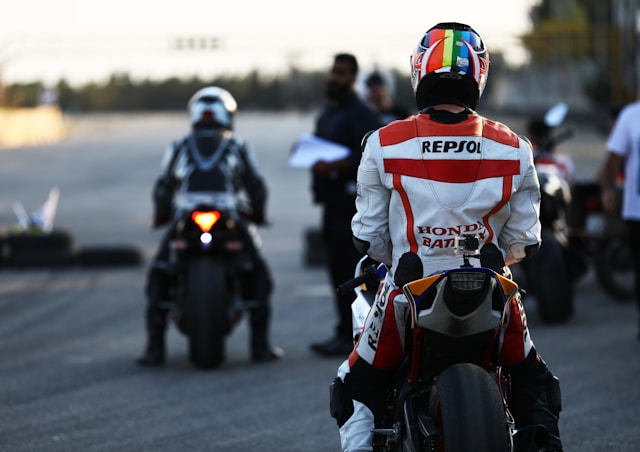
While there is a great deal of coverage of vehicle engineering and aerodynamics in motorsport, the conditions within a race car cockpit are among the most physiologically demanding in professional sport, yet receive relatively little coverage: cockpit temperatures can exceed 50°C, sweat loss can approach one litre per hour, noise levels routinely exceed 100 decibels, and drivers are in that environment for anywhere from 90 minutes to four hours, depending on the category. Heat stress, restricted movement, and communication failures all have implications for reaction time, cognitive function, and endurance.
Fitment Is Where Customisation Starts
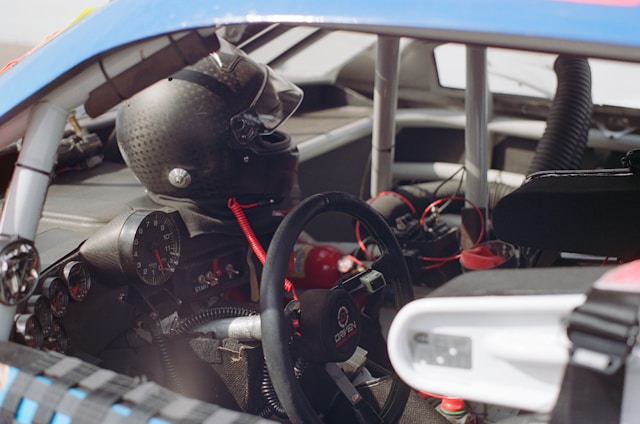
Professional drivers rarely race straight out of the box, and even small pressure points that would be negligible in regular clothing become distractions and irritations during a two-hour race. FIA-certified suits, helmets, gloves, shoes, and undergarments are regularly modified to perfectly conform to each driver’s body shape, as research into racing suit performance indicates that protective garments have a major impact on thermal comfort, and safety and mobility are two often-competing goals that must be balanced by proper fit.
Custom fitment has practical weight in Australian motorsport, where circuit racing and endurance events are often held in hot environments, and teams measure every millimetre of the driver’s body and use pressure mapping to see where too much material limits movement in the shoulders, knees, and elbows. A company like RPM Racegear offers custom-sizing options that focus on resolving those specific problem areas rather than making a blanket adjustment across the entire suit, which results in a suit that moves with the driver, not against them, which is a comfort upgrade that is a performance upgrade.
Heat Is The Performance Threat That Customisation Addresses Most Aggressively
Formula One research has documented cockpit air temperatures of 36°C to 66°C during competition, which causes increased body heat to be correlated with decreased cognitive performance and impaired decision-making outcomes that are immediately translated into lap time and strategic errors. The problem is compounded by sweat loss approaching one litre per hour, which dehydrates the driver and impairs concentration and physical output long before the driver subjectively notices. This is why thermal management has become one of the most studied topics in motorsport: The performance cost of getting it wrong is both measurable and significant.
Ventilated suits are just the beginning of modern cooling solutions. Professional drivers wear cooling garments under their fire-resistant suits, which have systems that circulate cooled liquid through networks of tubes embedded in specialised shirts (FIA-approved versions for extreme heat conditions have about 48 metres of tubing across the torso), helmet ventilation systems, insulated hydration lines, and airflow channels designed for the driver’s seating position and the specific geometry of the cockpit of their car. It is customised to individual physiology rather than applied as a package.
Gloves And Seat Inserts — Where Marginal Gains Accumulate
One of the most accurate interfaces in motorsport is a glove, where the hands of a driver are in contact with a steering wheel that can have hundreds of inputs per lap; professional drivers adjust glove thickness, palm materials, seam placement, and finger construction for their own driving styles and for the specific surface texture of their steering wheel. The gloves have ventilation zones placed to control hand temperature while meeting fire resistance standards. At the highest levels of the sport, where steering consistency over a full race distance affects outcome, it is not uncommon to see silicone grip patterns on the fingers and palm tailored to specific wheel surfaces.
Communication Systems And The Case For Evidence-Based Customisation
With real-time information coming in about fuel consumption, tyre degradation, weather changes, and strategy adjustments, all arriving at more than 100 decibels of noise, modern racing demands constant communication between driver and engineer during a race delays or misunderstandings have a direct impact on outcomes. At the professional level, drivers have noise-cancelling microphones, custom-moulded earpieces, and digital audio filters, which they have individually tailored to their specific hearing sensitivity and the noise characteristics of their cockpit. This is not a matter of preference, it is a matter of reliability: drivers need the information to come through consistently, and standard equipment fails them under the conditions of racing.
For each customisation, there are trade-offs, and professional teams balance these against quantifiable performance data. Cooling systems add mass. Extra padding impacts vehicle packaging. Communication hardware adds to the complexity of a helmet. In 2025, Formula One cooling technology was discussed, and concerns were raised over larger garments and the need to redesign the seat to accommodate the systems, even as the systems measurably increased thermal protection. Teams measure driver heart rate, skin temperature, hydration loss, and lap-time consistency to see if each change is actually providing a net competitive advantage. This evidence-based approach is indicative of where motorsport has evolved: comfort is no longer a secondary consideration, addressed on the margins of performance engineering.